Published Methodology.
Validated Database.
Published methodology with DOIs. 1,682 ingredients validated across 20+ dimensions. 753 Gold-tier with primary source verification. 174 brand-specific contaminant products. 103 FDA recalls tracked. 18 infant formula profiles. 44 evidence-based articles. Research-backed, multi-dimensional exposure intelligence for maternal and infant health.
What I Wish I Had During Postpartum Brain Fog
There's a particular kind of panic that hits at 2:07 a.m. You're half-asleep, your baby's finally down, and you're holding a bottle of supplements you barely remember ordering – wondering if one of them is going to mess with your milk.
I was looking for a reliable breastfeeding supplement safety checker – but it didn't exist. I remember flipping the bottle over, scanning the ingredient list like it was written in another language. Sunflower lecithin, ashwagandha extract, "natural flavors," magnesium bisglycinate.
I just wanted to know if it was safe while nursing – not spend 30 minutes parsing Reddit threads. I opened four tabs. Found conflicting advice. Closed them all.
That night – groggy, postpartum, trying to be responsible – I realized I didn't need more opinions. I needed a tool built on actual science. Meet Clarity: a quiet little scanner that decodes ingredient labels – supplements, skincare, and food additives – for lactation safety, histamine response, DAO enzyme interaction, and cycle-phase sensitivity. Built by a research scientist who has studied these systems for over a decade.
"The internet loves bold claims about lactation supplement safety – but if you've ever tried fact-checking at 3am, you know not all advice is reliable."
- "Natural = safe." Plenty of herbs interfere with milk supply – sage, peppermint, parsley, turmeric in high doses.
- "If it's sold at Whole Foods, it's fine." Most supplements are not tested for breastfeeding safety – even the pretty ones.
- "You'll know if your baby reacts." Not always. Some reactions show up hours or days later.
- "Your skincare doesn't affect your baby." Topical ingredients can absorb transdermally. Retinoids, oxybenzone, and certain preservatives warrant a second look.
- "The label tells you everything." Labels tell you what's in it. Not whether it's safe for you, right now.
Built to be trusted. Not just used.
Trust in a health tool isn't given – it's earned through transparency, source traceability, and the honesty to say when evidence is limited.
"I finally felt like I had something I could trust. It cited sources. It told me when it wasn't sure. That's all I wanted."
– Mia R., postpartum mom"As an RN I've looked at a lot of health tools. This is the first one I'd actually recommend to a patient. It tells you when it doesn't know."
– Kendra M., RNSix capabilities. One standard.
Precision analysis for questions where evidence quality actually matters – supplements, skincare, food ingredients, and the protocols you're following.
Supplement & Botanical Safety
1,682 ingredients assessed across 20+ dimensions: herbs, vitamins, minerals, amino acids, enzymes, hormones, and food additives. 753 Gold-tier with primary source verification. Evidence-graded with Gold, Silver, and Bronze tiers. Cross-referenced against LactMed, InfantRisk, and SIGHI. Includes blood pressure classification and drug interaction warnings.
- LactMed, InfantRisk, & MilkSafe sourced verdicts
- Galactagogue and anti-galactagogue flags
- 28 clinically curated ingredient interactions
- Breast milk transfer risk rating (Low/Medium/High)
Skincare & Topical Ingredient Safety
105 validated skincare actives checked for breastfeeding safety – retinoids, sunscreens, exfoliants, preservatives, and more. Paste your full ingredient list and get a verdict per ingredient.
- Retinoids, AHAs, BHAs, vitamin C forms
- Sunscreen filters – chemical vs. mineral
- Preservatives: parabens, phenoxyethanol, formaldehyde releasers
- PMIDs cited where available
Histamine & DAO Enzyme Analysis
The only consumer tool that simultaneously flags histamine content AND DAO enzyme inhibition – the combination that determines real-world histamine load, not just ingredient-level risk.
- Histamine liberator classification with severity rating
- DAO inhibitor flag with severity (compounds the histamine effect
- Infant sleep impact: histamine is wake-promoting via breast milk
- Cycle-phase modulation: ovulation peak sensitivity
Protocol & Evidence Review
Assess a supplement stack or skincare routine against published evidence – what's supported, what's preliminary, what's risky in combination.
- Evidence mapping across each protocol element
- Study design assessment – RCT, cohort, in vitro
- Cumulative dose and combination risk flags
- Questions to bring to your clinician
CMPA & Allergen Safety
Full cross-reactivity mapping for cow's milk protein allergy across mammalian milks. Safe alternatives documented. FDA Big 9 allergen classification for every ingredient.
- Cow → goat → sheep → buffalo cross-reactivity chain
- CMPA-safe alternatives: pea protein, rice protein, oat, hemp
- A2 milk flagged as not CMPA-safe
- Big 9 and emerging allergen classification
Pregnancy & Toddler Safety
Separate pregnancy verdicts with trimester-specific cautions. Toddler safety ratings with ADHD-linked additive flagging, heavy metal alerts, and pediatric dose guidance.
- Pregnancy ≠ breastfeeding: separate verdicts for each
- ADHD-linked additives: artificial colors, BHA, BHT, TBHQ
- Heavy metals: arsenic in rice, cadmium in cocoa, lead in spices
- Contaminant alerts: brand-specific arsenic, lead, cadmium, mercury, glyphosate. 174 products from FL DOH (2026), EWG, HBBF
- 28 clinically curated ingredient interactions
Published research. Validated data layers.
Clarity is not just a tool. It is a research platform with published methodology and multiple validated data layers that no other consumer health tool offers.
Two published studies with DOIs, establishing Clarity as a research-credentialed platform, not just a consumer tool.
Beta-Glucan Galactagogue. DOI: 10.5281/zenodo.19389747 CMPA Formula Analysis. DOI: 10.5281/zenodo.19391415Brand-specific testing data for arsenic, lead, cadmium, mercury, and glyphosate. Sourced from Florida DOH (2026), EWG, and HBBF. Scan a barcode and see contaminant alerts alongside ingredient safety analysis.
Active tracking of FDA enforcement reports covering baby food, infant formula, and supplement recalls. Integrated into ingredient lookups so users see recall history alongside safety verdicts.
15-dimension comparative analysis of 18 infant formula products. CMPA-safe options mapped. Published in the CMPA Formula Analysis preprint. The only multi-dimensional formula comparison available to consumers.
Clarity's research has corrected widespread misconceptions in maternal health: the brewer's yeast galactagogue claim (no human RCT evidence supports it as a standalone galactagogue), the oats galactagogue correction (commonly recommended but beta-glucan mechanism is the active pathway, not oats per se), and the goat milk CMPA safety myth (92% casein cross-reactivity with cow's milk). These corrections are documented in published preprints and the 44 evidence-based articles in the Clarity Insights series.
The Spinach Test: How Multi-Axis Classification Works in Practice
A user queries spinach. A generic tool returns "generally safe." Clarity returns six simultaneous signals: High histamine content, Does not inhibit DAO enzyme, Use with caution during Ovulation, Safe for pregnancy, Safe for toddlers (but oxalate-rich), and No heavy metal concern.
That distinction matters. Spinach is a histamine liberator – but because it doesn't inhibit DAO, the body can still clear histamine normally. The risk profile is different from an ingredient that does both. Clarity also flags that it's oxalate-rich, which matters for toddler kidney health. No other consumer tool makes these distinctions simultaneously.
This is the cross-column inference layer. Same ingredient, six dimensions, one calibrated output. Database-first, consistent every time.
| Signal | Generic Tool | Clarity |
|---|---|---|
| Verdict | Generally safe | ⚠ Caution |
| Histamine | Not flagged | 🔴 High histamine |
| DAO enzyme | Not checked | ✓ Does not inhibit |
| Cycle phase | Not checked | 🌙 Caution: Ovulation |
| Pregnancy | Not checked | ✓ Safe |
| Toddler | Not checked | ⚠ Safe (oxalate-rich) |
| Source | GPT summary | DB validated · Gold tier |
Same question. Two wrong answers.
Until we fixed it.
Before the database-first architecture, the same breastfeeding supplement query returned a different verdict every session. Safe one time, nothing the next. No change in evidence. Just a language model sampling differently. Here's the before and after.
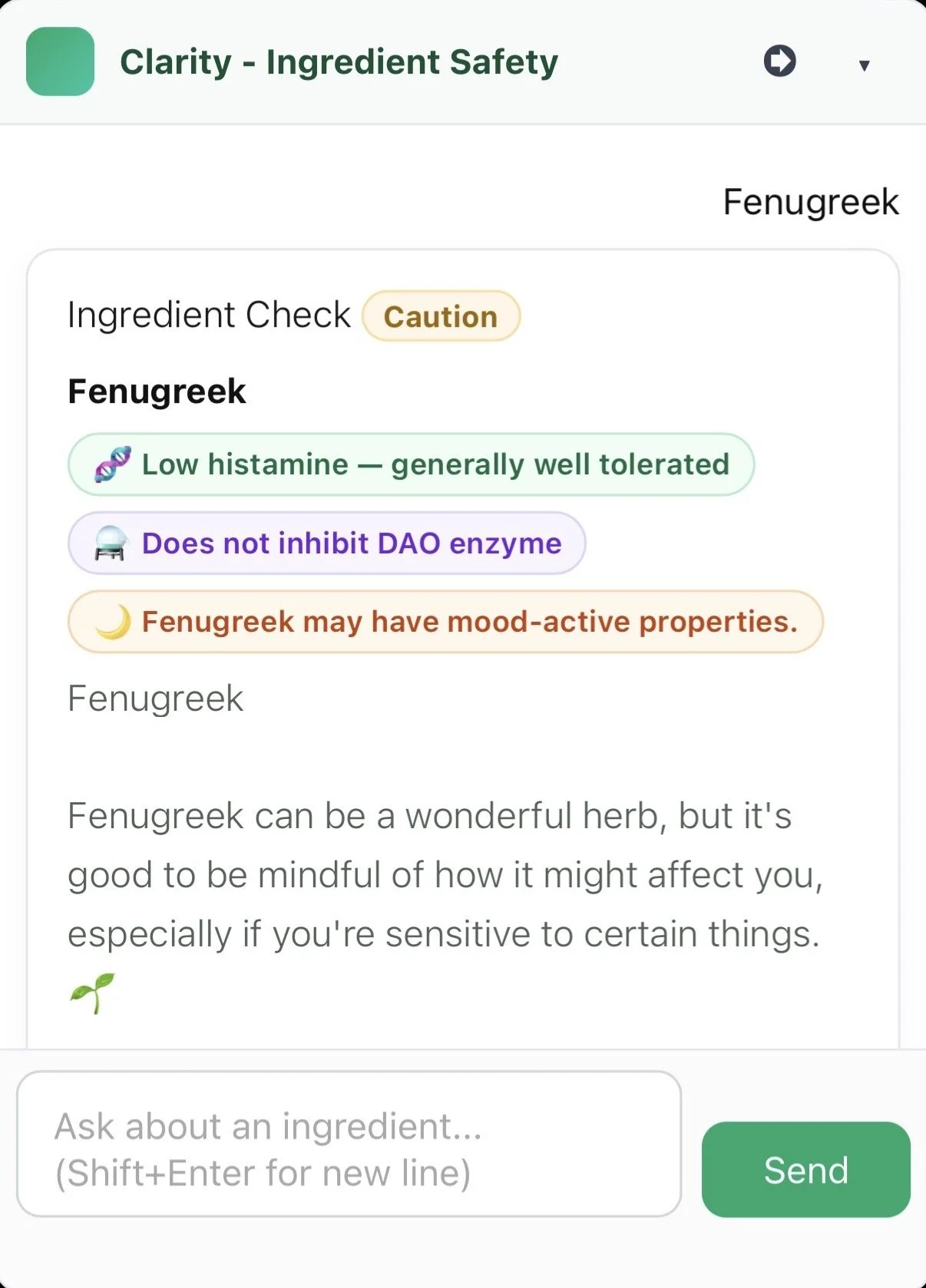

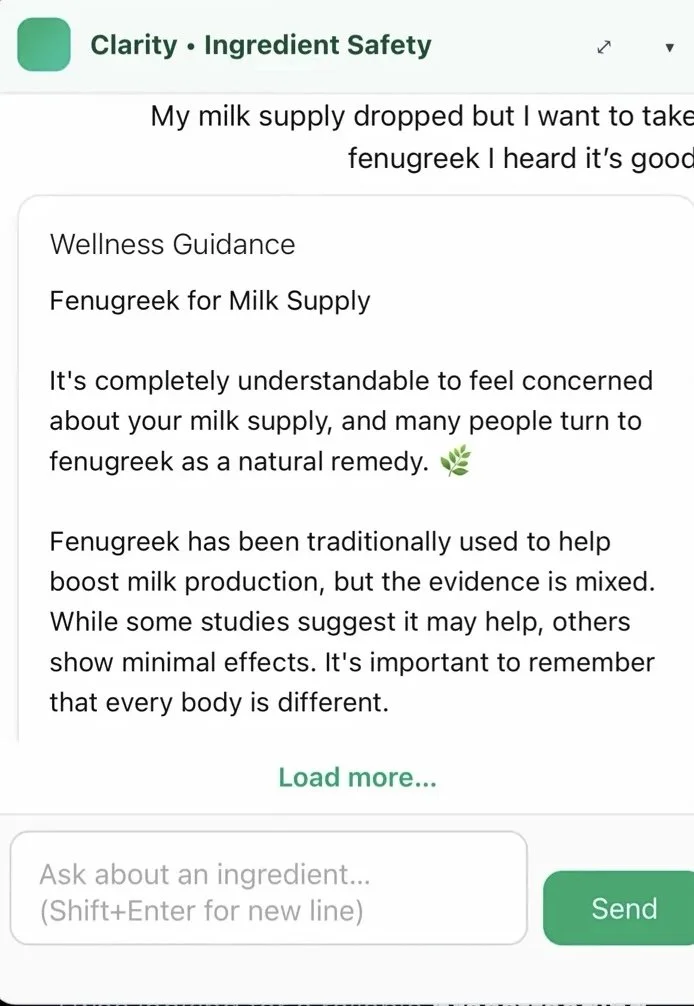
The database-first architecture means the breastfeeding supplement verdict is pulled from validated rows, not regenerated each session. GPT is invoked only when an ingredient has no database record. The fix eliminated verdict variance for 1,682 validated ingredients.
Six things no other health AI tool does.
The RIGOR™ Framework, Applied to Consumer Health AI
The same five-pillar validation discipline that governs deployment-grade clinical AI is the standard Clarity is built to. Not a governance disclaimer added afterward – methodology embedded from the start.
Requirements – Scope and Limits Are Formally Defined
What Clarity answers, and what it explicitly does not.
Implementation – Source Architecture Is Documented
Evidence provenance is traceable, not assumed.
Governance – Uncertainty Is Structurally Represented
Confidence calibration is a design requirement, not an afterthought.
Operational Proof – Validated Against Expert Review
Performance tested before deployment, not after user complaints.
Runtime Monitoring – Accuracy Is Tracked, Not Assumed
Deployment is not the end of accountability.
Not all health AI is the same.
The consumer health AI market is growing fast. The validation standards are not keeping pace.
| Capability | Clarity | Typical Health AI Apps | General LLMs |
|---|---|---|---|
| Supplement + skincare + food ingredient checking | ✓ | ✗ | Partial |
| Histamine + DAO enzyme dual classification | ✓ | ✗ | ✗ |
| Cycle-phase sensitivity flags | ✓ | ✗ | ✗ |
| Evidence quality signals on every output | ✓ | ✗ | ✗ |
| Consistent verdicts – database-first architecture | ✓ | ✗ | ✗ |
| PubMed citations per ingredient | ✓ | ✗ | ✗ |
| Formally validated methodology (RIGOR™) | ✓ | ✗ | ✗ |
"A consumer health tool that cannot show you the evidence behind what it tells you is not a health tool. It is a confidence generator."– Olga Lavinda, PhD, CEO, Health AI
Could your diet be affecting
your baby's sleep?
Most breastfeeding safety tools stop at lactation. They tell you if something transfers to breast milk. They don't tell you what happens after it does.
Histamine from high-histamine foods and supplements transfers into breast milk. Infants have the same H1 receptors that promote wakefulness in adults. In the same way antihistamines cause drowsiness, histamine promotes alertness. A mother eating high-histamine foods in the evening may be a contributing factor to why her baby is harder to settle at night.
This is not a diagnosis. Individual responses vary, and many factors affect infant sleep. But if you're noticing patterns (fussiness, gassiness, difficulty settling, or eczema that seems to correlate with feeds), histamine load is worth exploring with your provider.
The same mechanism explains why some infants flagged as CMPA-reactive (cow's milk protein allergy) only partially improve on dairy-free diets. If histamine, not protein, is the driver, removing dairy doesn't solve it. Clarity checks for both dimensions.
"I had no idea spinach was high in histamine. I was having it every day thinking it was healthy. Clarity flagged it, and it was the first thing that helped me make sense of the pattern."
– Clarity user, postpartum"Governance is a stronger predictor of success in healthcare AI than model performance or investment level."
Healthcare AI industry analysis, 2025"A large proportion of healthcare AI pilots still fail to scale due to unresolved governance and validation gaps, not technology gaps."
Healthcare AI industry analysis, 2025Clarity is built to be the exception: a consumer health AI tool where the governance came first, not after the complaints.
FAQ
What are 1,682 validated ingredients?
Each entry in Clarity's database is a fully explored safety profile, not just a data point. For every ingredient, 20+ dimensions are investigated simultaneously: lactation safety, pregnancy safety, toddler safety, histamine signal, DAO enzyme interaction, cycle-phase sensitivity, CMPA cross-reactivity, ADHD-linked additive risk, heavy metal contamination, allergen classification, and more. The connections between them are mapped, the evidence is tiered by source quality, and PubMed citations are attached. 753 ingredients are Gold-tier, cross-referenced against LactMed, InfantRisk, or MilkSafe.
Could my diet be making my baby fussier or harder to settle?
Possibly, and it's worth exploring. Histamine from high-histamine foods transfers into breast milk. Infants have the same H1 receptors that promote wakefulness in adults. If you're noticing patterns in your baby's behavior after certain feeds, histamine load from your diet may be a factor worth discussing with your provider. Common sources include fermented foods, aged cheese, spinach, tomatoes, and certain supplements. This is not a diagnosis. Individual responses vary. But Clarity flags histamine and DAO status so you can check specific ingredients you eat regularly.
What is histamine intolerance and why does it matter postpartum?
Histamine intolerance occurs when the body cannot clear histamine fast enough, leading to symptoms like headaches, flushing, congestion, and GI distress. The enzyme diamine oxidase (DAO) clears dietary histamine. Some ingredients trigger histamine release; others block DAO, compounding the load. Postpartum hormonal changes can affect DAO activity, making histamine sensitivity more pronounced in the months after birth. No other free consumer tool checks both histamine content and DAO inhibition simultaneously per ingredient.
Can I check my skincare ingredients while breastfeeding?
Yes. This is one of Clarity's core capabilities. Over 100 skincare actives are validated in the database, including retinoids, chemical sunscreen filters (oxybenzone, octinoxate), AHAs, BHAs, preservatives, and topical antibiotics. Some topical ingredients absorb transdermally and can transfer to breast milk. Paste your full ingredient list and Clarity returns a verdict per ingredient based on available evidence.
Is there a supplement that reduces milk supply I should know about?
Several ingredients are classified as anti-galactagogues: they may reduce breast milk supply. These include sage, peppermint in large amounts, parsley, and turmeric at high doses. These sometimes appear as fillers or flavoring agents in wellness products not marketed for lactation. Clarity flags anti-galactagogue status explicitly. If you're experiencing a supply drop that seems unexplained, checking your current supplements and foods is a logical first step.
How is this different from asking ChatGPT?
General AI tools are optimized for average performance across millions of queries. Clarity is built for consistency and accuracy on a specific clinical question. Before the database-first architecture was implemented, the same breastfeeding supplement query returned three different verdicts across sessions (Safe, Ambiguous, Caution) with no change in evidence. Clarity queries a validated database before invoking AI, so the same question returns the same answer every time. The case study is documented on this page with screenshots.
How does cycle phase affect supplement safety?
Hormone fluctuations across the menstrual cycle affect how the body responds to certain ingredients. During ovulation, peak estrogen drives histamine sensitivity, making high-histamine foods and liberators more likely to cause symptoms. During the luteal phase, stimulants and certain adaptogens may amplify their effects. Clarity flags which cycle phases warrant caution for each ingredient, based on endocrinology literature. As your cycle returns postpartum, these signals become increasingly relevant.
Is the evidence in Clarity peer-reviewed?
Yes. Clarity draws from LactMed (NIH), DSLD (NIH Dietary Supplement Label Database), InfantRisk, MilkSafe, DermNet, and peer-reviewed pharmacology journals. Evidence is tiered: Gold (cross-referenced against LactMed, InfantRisk, or MilkSafe with PMID citations), Silver (PubMed confirmed), Bronze (Clinical Review Pending). 900+ of the 1,682 validated ingredients have PubMed citation IDs attached. 753 are Gold-tier. Published research with DOIs validates the methodology. Every response reflects the source tier, so you know exactly what kind of evidence you're looking at.
Is goat milk safe for a baby with cow's milk protein allergy (CMPA)?
No. Goat milk shares approximately 90% casein protein homology with cow's milk. Most infants with CMPA will also react to goat milk, sheep milk, and buffalo milk. Clarity maps CMPA cross-reactivity across all mammalian milks and flags safe alternatives, including pea protein, rice protein, oat milk, and hemp protein. A2 milk is also flagged as not CMPA-safe despite marketing claims, because it still contains bovine casein and whey.
Which food dyes and additives are linked to ADHD in children?
Clarity flags ADHD-linked additives based on the Feingold Association list, Southampton Six research, and CSPI ratings. Key flagged ingredients include FD&C Red 40, Yellow 5 (Tartrazine), Yellow 6 (Sunset Yellow), Red 3 (Erythrosine), Blue 1, Blue 2, BHA, BHT, TBHQ, sodium benzoate, and calcium propionate. Several of these require warning labels in the EU but remain approved in the US. Clarity rates each additive for toddler safety separately from adult safety.
Does Clarity check for heavy metals in baby food ingredients?
Yes. Clarity flags ingredients with known heavy metal contamination risks, including rice products (arsenic), cocoa/chocolate (cadmium), turmeric and spices (lead), bone broth (lead), and spirulina (varies by source). Each flagged ingredient includes a bioaccumulation risk rating and specific guidance for infant and toddler consumption.
Does Clarity check pregnancy safety separately from breastfeeding?
Yes. This is a critical distinction most tools miss. An ingredient can be safe during breastfeeding but risky during pregnancy (or vice versa). Clarity provides separate pregnancy safety verdicts with trimester-specific cautions. For example, some herbs are uterine stimulants (avoid in pregnancy) but galactagogues (helpful for milk supply postpartum). Clarity flags both, with different verdicts for each context.
Can histamine in my diet affect my baby's sleep through breast milk?
Research suggests it can. Histamine is a wake-promoting neurotransmitter. High-histamine foods (aged cheese, fermented foods, cured meats, wine, spinach) can raise histamine levels in breast milk. Infants have H1 receptors that promote wakefulness. Clarity flags histamine liberators and DAO inhibitors (ingredients that raise histamine or block its clearance) and notes the potential infant sleep impact for each ingredient.
What is the safest protein powder while breastfeeding with CMPA?
Pea protein is the most commonly recommended CMPA-safe protein source. It has no cross-reactivity with cow's milk proteins. Rice protein is the most hypoallergenic option. Hemp protein is also CMPA-safe with no legume or nut cross-reactivity. Soy protein is not recommended as a CMPA alternative because 10-15% of CMPA infants also react to soy. Whey and casein protein powders must be completely eliminated during CMPA. Clarity provides detailed CMPA cross-reactivity mapping for all protein sources.
Go Deeper
Want the methodology behind the tool?
The RIGOR™ Framework is publicly available – including the full five-pillar lifecycle model and its alignment with NIST, FDA, and EU AI Act standards.
View the RIGOR™ Framework Talk to Health AI
Built By
Olga Lavinda, PhD
CEO of Health AI and research scientist specializing in AI validation, polypharmacology, and translational science. Dr. Lavinda developed Clarity from her research background in polypharmacology, chemometrics, and NIH-funded translational science – applying the same validation rigor to consumer health intelligence that she applies to clinical and enterprise AI systems. healthai.com · LinkedIn · @OlgaLavindaPhD
The Clarity dataset is continuously enriched from primary literature sources including LactMed (NIH), DSLD (NIH Dietary Supplement Label Database), MilkSafe, InfantRisk, DermNet, and peer-reviewed pharmacology journals. Evidence is tiered by source quality. All enrichment scripts are version-controlled and all changes are verified against primary sources before deployment.
Health AI · Clarity · Checker · ChatGPT · API · Blog · Methodology · Contact
Olga Lavinda, PhD · CEO, Health AI · © 2026 Health AI LLC. RIGOR™ is a trademark of Health AI.
Clarity is an informational tool and does not constitute medical advice. Consult a qualified healthcare provider before making decisions about supplements, medications, or health protocols.