

Published research.
Validated data.
Real answers.
Peer-reviewed methodology. 1,500+ ingredients across 20+ safety dimensions. Measured biogenic amine concentrations from 12 published studies. 172 histamine-producing bacterial strains catalogued. 174 contaminant products tested. Database-first. Multilingual — search in 9 languages.
20+ dimensions.
Five lenses.
Most tools give you one verdict. Clarity checks across 20+ safety dimensions and adapts to your condition: breastfeeding, histamine intolerance, MCAS, rosacea, HS, or food allergy.
Evidence-graded verdict for breastfeeding from LactMed (NIH), InfantRisk, and MilkSafe. Gold, Silver, and Bronze tiers with PMID citations.
Measured mg/kg concentrations from 12 published studies. DAO inhibition. Putrescine, tyramine, and cadaverine levels. 268 MCAS triggers flagged. 172 histamine-producing bacterial strains catalogued.
Rosacea trigger flags across foods and 92 skincare ingredients. Vasodilators, mast cell activators, cinnamaldehyde, and histamine-mediated flushing identified.
HS flare triggers: dairy, brewer's yeast, high-GI foods, nightshades. Mast cell connection mapped (mast cells upregulated in HS lesions). Inflammation pathway flagging.
Big 9 allergen flagging (milk, eggs, fish, shellfish, tree nuts, peanuts, wheat, soy, sesame). Asthma triggers. Dietary histamine reduces peak flow in children (RCT, p=0.0006).
Trimester-specific safety assessments. Flags uterine stimulants, teratogens, and endocrine disruptors. Pregnancy safety and breastfeeding safety are not the same.
265 ingredients flagged for sleep disruption. Histamine promotes wakefulness via H1 receptors. Evening dietary choices mapped to infant sleep through breast milk transfer.
47 hypotensive and 15 hypertensive compounds flagged. Critical postpartum — common supplements can stack with antihypertensives unpredictably.
172 histamine-producing bacterial strains catalogued — including 17 sold as probiotics. Scan a supplement label and check if the strains produce histamine.
Brand-specific arsenic, lead, cadmium, mercury, and glyphosate data. 174 products tested from Florida DOH (2026), EWG, and HBBF.
Measured putrescine, tyramine, and cadaverine from peer-reviewed studies. These compounds compete with histamine for DAO clearance — the hidden triggers most tools miss.
Search in 9 languages. Every ingredient mapped across English, Spanish, Hindi, French, Arabic, Portuguese, Chinese, German, and Japanese.
Could your diet be affecting
your baby's sleep?
Some breastfeeding mothers notice their baby is fussier, harder to settle, or more wakeful after certain meals. While individual responses vary, histamine-containing foods and supplements may be worth exploring as a possible factor — particularly for babies who seem sensitive after feeds.
Histamine transfers into breast milk. Infants have the same H1 receptors that promote wakefulness in adults. If you're noticing patterns, Clarity flags histamine and DAO status so you can check specific ingredients you're eating regularly — and have a more informed conversation with your provider.
— Clarity user, postpartum
Individual responses vary. Many factors affect infant sleep. Clarity gives you the ingredient data — your provider gives you the clinical interpretation.
They needed an answer.
Not another opinion.
Clarity gives you an evidence-graded verdict, the source it came from, and the honesty to say when evidence is limited.
"I kept getting headaches and my baby was fussy. Nobody connected it to histamine. Clarity flagged it immediately."
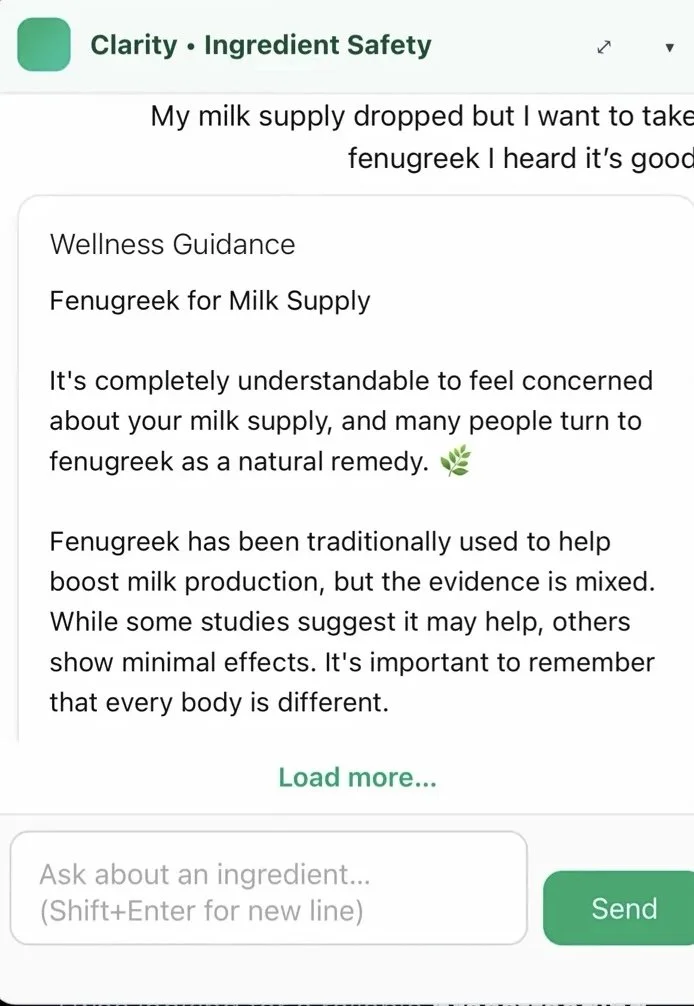
"My milk supply dropped. Turned out it was peppermint in my protein powder. Would never have found it without this."
"As an RN, this is the first health tool I'd actually recommend to a patient. It cites sources and tells you when it doesn't know."
"Finally something that doesn't flood me with fear or ads. Just the information I need, graded by evidence."
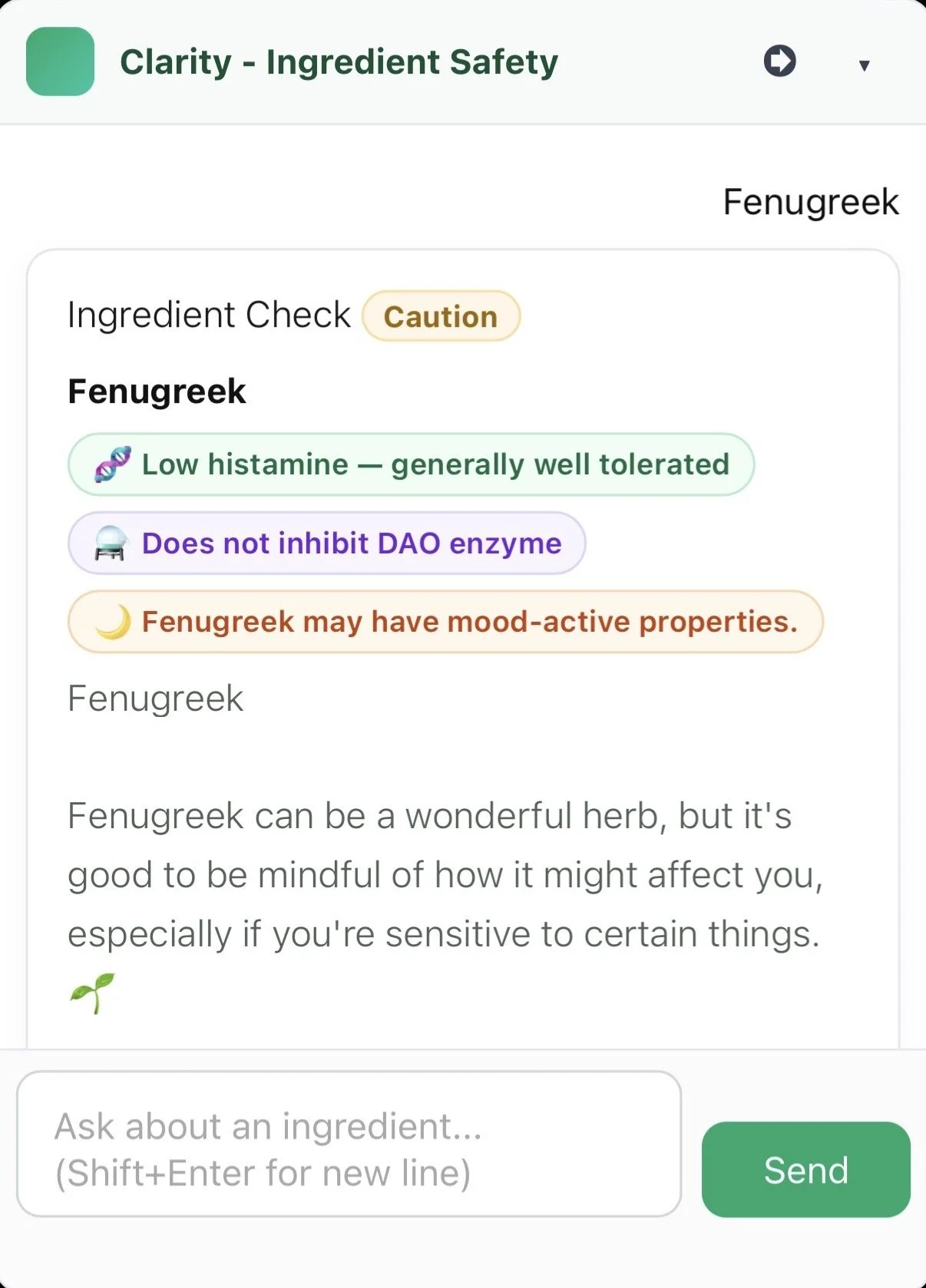
"I was 3 weeks postpartum, exhausted, and panicking over fenugreek. Clarity gave me an actual answer in 10 seconds — not a Reddit thread."
Not all health AI
is the same.
Generic AI gives you an answer. Clarity gives you an evidence-graded answer with the reasoning, the source, and the honesty to say when it doesn't know.
| Capability | ✦ Clarity | Typical Health Apps | Generic AI |
|---|---|---|---|
| Lactation safety verdict | ✓ | Partial | Partial |
| Histamine content flagging | ✓ | ✗ | ✗ |
| DAO enzyme interaction | ✓ | ✗ | ✗ |
| Cycle-phase sensitivity flags | ✓ | ✗ | ✗ |
| Pregnancy trimester warnings | ✓ | ✗ | Partial |
| Toddler safety & ADHD additive flags | ✓ | ✗ | ✗ |
| CMPA cross-reactivity mapping | ✓ | ✗ | ✗ |
| Heavy metal contamination alerts | ✓ | ✗ | ✗ |
| Ingredient interaction matrix | ✓ | ✗ | ✗ |
| Consistent answer every query | ✓ | Partial | ✗ |
| GLP-1 / weight loss medication safety | ✓ | ✗ | Partial |
| Primary source citations | ✓ | ✗ | ✗ |
| MCAS / mast cell trigger flagging | ✓ | ✗ | ✗ |
| Rosacea trigger detection | ✓ | ✗ | ✗ |
| Measured biogenic amine concentrations | ✓ | ✗ | ✗ |
| Probiotic strain histamine check | ✓ | ✗ | ✗ |
| RIGOR™ validated methodology | ✓ | ✗ | ✗ |
| Free, no sign-up | ✓ | ✗ | Partial |
Same question.
Two wrong answers.
Until we fixed it.
Before the database-first architecture, the same breastfeeding supplement query returned different verdicts every session. No change in evidence — just a language model sampling differently. Clarity now queries a validated database first. Same query, same answer, every time.

Evidence-graded exposure intelligence for maternal health, histamine intolerance, and beyond.
Peer-reviewed methodology. 1,500+ validated ingredients. 172 bacterial strains. 12 published sources. Condition-specific lenses for MCAS, rosacea, HS, allergy, and asthma. Read the full methodology →